
The Invisible School of Cagsawa
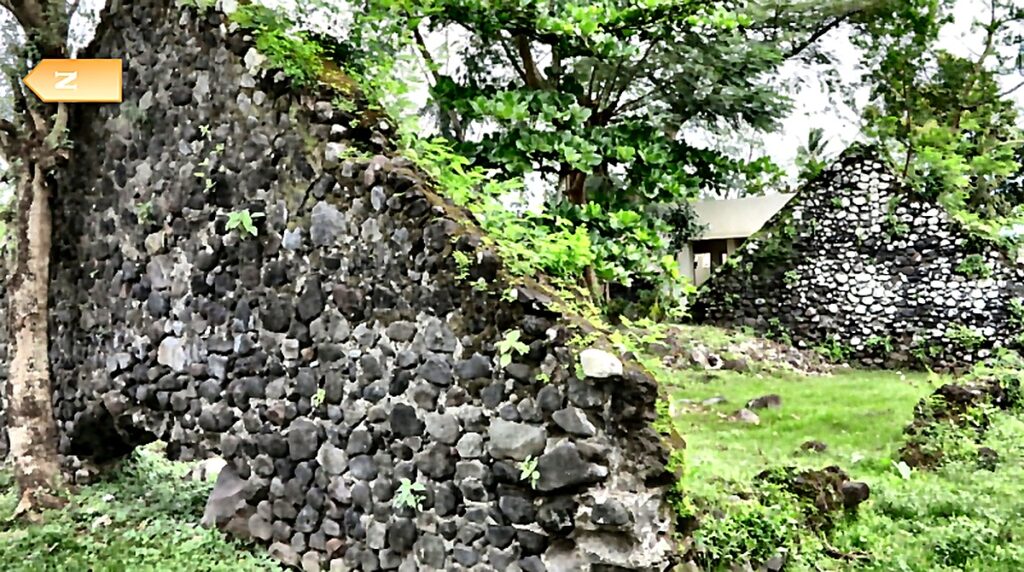
Everyone photographs the belfry. Almost no one asks about the schoolhouse that once stood beside it, buried, forgotten, and only recently found again.
Reimagined from an 1887 account by J.A. Guerra, and a 2018 SPAFA Journal survey
In 1887, a traveler named J.A. Guerra stood on the sand plain near the Daraga–Camalig road and noticed something odd. A clump of overgrowth, thick and stubborn, rooted in something harder than soil. He walked closer. Under the roots were stones. Cut stones, laid in courses, the bones of a building. Guerra called it the escuela of Cagsawa. The school.
Nobody photographs the escuela. What’s left of it isn’t much to look at, a low stone wall, easy to mistake for just another pile of rock with grass. But it’s one of the clearest pieces of evidence that Cagsawa, before the eruption that buried it, wasn’t just a church, it was a town with children in it, and a place where they were taught to read.
What Kind of School It Was
An escuela in a Spanish-era pueblo like Cagsawa wasn’t a grand institution. It was a basic primary school, reading, writing, arithmetic, Christian doctrine, and Spanish prayers, taught mostly to boys in the town’s early decades. Cagsawa was a Franciscan mission town, so the escuela almost certainly operated under church-led instruction, indirectly supervised by friars and local officials. A simple masonry or mixed-material building, unglamorous by design, doing exactly what a small-town school was meant to do.
Why this matters: the escuela is proof Cagsawa was a living community, children, teachers, daily lessons, not a lone church marooned in a field, which is how the ruins are usually pictured today.
Buried, Quietly
The escuela stood close to the church, near enough that their stones would later turn up in the same general ruin field. Then, in 1814, Mayon erupted, and later damage compounded the loss. Scattered stones and buried foundations were all that remained. The belfry survived tall enough to become a landmark. The escuela did not. It survived as a low, moss-covered pyramidal stone wall, nothing like the belfry’s height. Just quiet, unglamorous stone, doing what stone does when nobody’s rebuilding on top of it.
Finding It Again
Guerra’s 1887 account named the escuela. But naming a building from a description of overgrown mounds is not the same as finding it. For well over a century, the exact footprint of the school stayed a matter of inference, until archaeologists returned to question the ground itself.
From the record
A 2018 SPAFA Journal archaeological study of the Cagsawa Ruins left two structures unlabeled, their identities as escuela or casa tribunal still unconfirmed.
That gap has since closed. Structure D, to the southeast of the belfry, with distinctive pyramidal wall remains, has been identified as the escuela. After more than a century as an inference from a traveler’s notes, the school has a footprint again.
Why a School Matters to a Ruin
It would be easy to leave the escuela as a footnote, a labeling exercise resolved, a gap on a survey map filled in. But the reason it’s worth pausing on is bigger than nomenclature. A church tells you a town prayed. A school tells you a town raised children, taught them to read, expected them to have a future in that same plaza. Cagsawa wasn’t a monument waiting to happen. It was ordinary, functioning, and full of people, right up until it wasn’t.
That’s what makes the escuela the quiet witness in this story. Its stones don’t rise dramatically out of the sand the way the belfry does. They just sit there, identified now, proof that a whole town’s daily life, not only its faith, but its classrooms, was interrupted in a single eruption.
The escuela of Cagsawa never got its own postcard. But it got its own name back, Structure D, southeast of the belfry, pyramidal walls, a schoolhouse once again. That’s not nothing. That’s a town remembering how to spell its own name.